

Key points
- No, the government does not make a profit on student loans, even though they charge interest.
- In 2024, the government loses $19.64 for every $100 it lent, but in more “normal” years, it still loses $0.70 for every $100 it lent.
- Interest payments go to finance Treasury borrowing costs, services, defaults, and administrative overheads, not profit.
Does the government really make money on federal student loans?
The short answer: Sometimes, but not constantly and it depends largely on how you do your accounting. During the pandemic, eliminating interest payments on student loans has sent the program swinging from profit to loss even on the most optimistic projections.
In this article, we break down how the federal government calculates gains (or losses) on student loans, why accounting choices matter, the real numbers from federal budgets, and what it means for policy and taxpayers.
Would you like to save this?





What is net present value?
When a loan program generates revenue over time, you can evaluate the program’s total income by calculating the present value of future income. Income includes not only future interest payments but also future principal payments.
The simplified approach is to simply collect future payment amounts.
Total student loan income = sum of all future payments
but, A future dollar is worth less than a current dollarPartly due to inflation.
A more sophisticated approach calculates the present value of future payments by discounting them.
For example, if the annual inflation rate is 5%, a dollar a year from now has the same purchasing power as 95 cents today, and a dollar two years from now is worth slightly less than 91 cents today. The cumulative effect is calculated on the basis of the discounted value product for each year.
The present value depends on the choice of the discount rate. Popular options include the inflation rate and the risk-free rate of return. The yield on US Treasury securities with a similar maturity is often used as the risk-free rate of return because investments in US Treasury securities are low risk.
In fact, present value is the amount you would need to invest now in a risk-free investment to achieve a future stream of loan payments.
The present value of student loan income= The present value of all future payments discounted using inflation and the rate of return
However, there are often philosophical differences in choosing a risk-free rate of return.
The Federal Credit Reform Act of 1990 specifies the methodology to be used in the federal budget.
However, some people find the discount rate to be too low. They advocate the use of fair value accounting (FVA), which uses a higher discount rate because it takes market risk into account. But government programs are not subject to the same risks as commercial programs. Oddly enough, proponents of fair value accounting are often selective in choosing the programs for which they feel fair value should be used, so the
The debate appears to be more political than policy driven.
A A higher discount rate reduces the value of future income by more than a lower discount rate. After subtracting costs from the present value of future income, you can swing it from profit to loss or vice versa, depending on the choice of discount rate.
What does the federal budget say?
the Education supplement to the federal budget(PDF) Includes an analysis of the costs of the student loan program, which are referred to as subsidies. It includes actual numbers for the previous year and estimates for the current year and next year.
Support costs are broken down by loan type, including New Subsidized Federal Direct Stafford Loans, Unsubsidized Federal Direct Stafford Loans for undergraduate and graduate students, New Federal Direct Parent PLUS Loans and Federal Direct Grad PLUS Loans, as well as Federal Direct Consolidation Loans. There is also an overall figure for loan support, as well as a general figure for federal administrative costs.
This table shows actual support costs from the federal budget over the past several federal fiscal years. Positive numbers indicate net cost while negative numbers indicate net profit.So, if you’re wondering where the government can leverage your student loans, look for loan programs that have a negative number (like Parent Plus Loans).
Program costs are expressed as percentages. For example, a charge of 2% means it costs the federal government $2 over the life of the loan based on the net present value of every $100 borrowed.
The Federal Direct Loan Program went from profitable during the Obama administration to losing money during the Trump administration. The loss increased significantly in fiscal 2020 due to payment interruptions and interest waivers during the pandemic.
Subsidized Stafford loans always have a net cost due to the interest cost of the subsidized interest. Parent PLUS loans are usually profitable due to high interest rates and low default rates, which offset losses in other loan programs.
This table below shows actual costs from the most recent full year (FY 2024), and we compare them to FY 2018 before the pandemic and FY 2017 – which was one of the most “normal” years of the past decade.
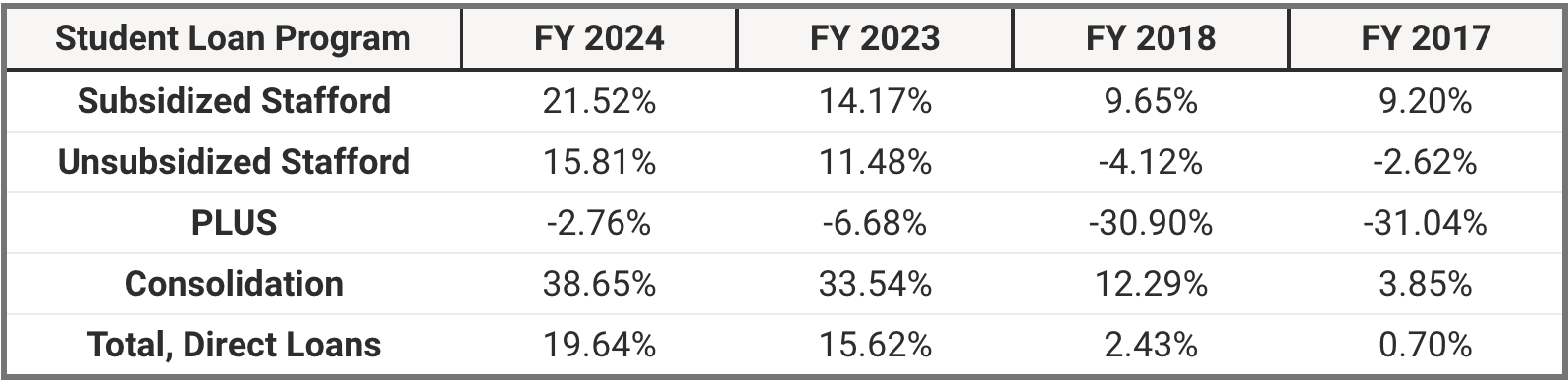
This data was collected from Federal Budget Supplement and Ministry of Education budget supplement.
Student loan program | Fiscal year 2024 | Fiscal year 2023 | Fiscal year 2018 | Fiscal year 2017 |
|---|---|---|---|---|
Stafford supported | 21.52% | 14.17% | 9.65% | 9.20% |
Stafford unsupported | 15.81% | 11.48% | -4.12% | -2.62% |
plus | -2.76% | -6.68% | -30.90% | -31.04% |
Unification | 38.65% | 33.54% | 12.29% | 3.85% |
Total direct loans | 19.64% | 15.62% | 2.43% | 0.70% |
To summarize the table a bit, this means that in fiscal year 2024, federal student loan programs cost the government $19.64 for every $100 borrowed. In “normal” years like 2017, the federal student loan program costs the government $0.70 for every $100 borrowed.
Support costs are based, in part, on interest and fees, the length of the average loan maturity, default rates, delinquency net of recoveries, and the recovery rate.
The average loan maturity is 17 years, the lifetime default rate is 19.13%, and the recovery rate is 104.74%.
The net recovery rate for non-performing loans is about 80 to 85 cents on the dollar after subtracting collection costs. The repayment rate is much higher than for business loans, in part because the federal government has very strong powers to compel repayment, including administrative wage garnishment, offset of income tax refunds and offset of Social Security benefit payments.
Program costs must be re-estimated periodically, in part due to changes in interest rates and other assumptions. Re-estimates are usually higher than the original support rates. Therefore, even if a loan program initially appears to generate a profit, it may ultimately result in a net cost after the program’s costs are re-estimated.
The focus of federal student loan programs is to enable students to pay for a college education and not to provide profit to the federal government.
Where does all the money go?
Borrowers often wonder how the U.S. Department of Education spends the interest borrowers pay on federal student loans in the Direct Loan Program. Most of the money goes to cover the costs of making, servicing, and collecting student loans, as well as defaults, discharges, and loan forgiveness.
- Federal student loans are financed by issuing U.S. Treasury securities, which are money borrowed from investors. The federal government must pay interest on US Treasury bonds. So, part of the interest that borrowers pay covers the cost of funds used to make loans. There are also fees paid by the US Department of Education to the US Treasury to cover the costs of issuing and administering US Treasury securities.
- Loan servicers are charged a fee to service federal student loans. Loan servicing includes originating loans, tracking loans, communicating with borrowers, mailing loan statements, customer service (e.g., call centers), processing payments, following up on delinquent borrowers and complying with federal laws and regulations. Loan servicers are paid on a unit cost basis, where each borrower is paid a fixed amount, depending on the repayment status of the borrower’s loans. Service fees range from $0.45 to $2.85 per borrower per month.
- Subsidized interest interest, where the federal government pays interest on subsidized Federal Direct Stafford Loans during school periods and grace periods, as well as authorized deferral periods, reduces the interest income the federal government may receive. Additionally, interest on federal student loans held by the U.S. Department of Education has been waived during the COVID-19 pandemic.
- Federal student loans have much higher default rates than private student loans, in part because federal student loans are not co-signed and are offered to borrowers without regard to credit scores or debt-to-income ratios. Even with the higher recovery rate, there is still a cost associated with collecting non-performing loans, and net revenue is less for borrowers whose loans are still current. The average amount collected, after subtracting collection costs, is less than the amount due.
- Student loan forgiveness and discharge programs work to reduce the interest and principal on canceled student loan debt.
- There are also additional administrative burdens for U.S. Department of Education employees who oversee loan servicers and collection agencies.
If there is a profit on federal student loans, the net proceeds will be used to cover the cost of other federal student aid programs, such as the federal Pell Grant and federal work-study programs. When federal legislation includes cutting the cost of federal student loan programs, Congress often uses the savings to justify increased spending in other parts of the U.S. Department of Education budget.
Frequently asked questions about government dividends and student loans
Does the federal government make money from student loans?
It depends on the accounting method used. Under federal credit repair accounting, student loans often appear to generate a small surplus because the government borrows at low interest rates and charges borrowers higher rates. However, when using “fair value” accounting (adjusting for market risk), loans typically show a loss, not a profit.
Why do loan profit estimates change from year to year?
Estimates change when real-world data replaces forecasts. Each year, the Office of Management and Budget (OMB) re-estimates support costs based on updated payment rates, defaults, and economic conditions. For example, during the 2019 coronavirus moratorium, what looked like a net gain turned into significant losses due to interest being waived.
Where does the interest on federal student loans go?
The interest payments go to the US Treasury, not a private company. These funds help offset government borrowing costs, loan servicing expenses, and loan defaults. It is not a direct “profit” in the institutional sense – it is simply a means of recouping the costs of the program.
Do any student loan programs make money?
Parent PLUS and Graduate PLUS loans have historically been closer to breakeven or slightly positive, although that varies by year.
Does loan forgiveness mean taxpayers lose money?
The exemption is recorded as a cost to the government because it reduces the expected payment. The actual financial impact depends on the amount of debt to be cancelled, the timing, and how this affects repayment behavior in the long term.
Is making a “profit” the goal of a student loan program?
no. The primary purpose of federal student lending is to expand access to higher education. The government’s goal is to keep the program’s budget neutral over time, not to generate revenue.
Editor: Robert Farrington
Reviewed by: Chris Mueller
The post Does the government benefit from student loans? appeared first on The College Investor.



