


For many decades now, the blueprint for creating a sophisticated investment portfolio has been well known: stocks, bonds, real estate, and alternative assets. But as the global economy continues to migrate online, a new asset class has evolved from a novelty to a necessity: the premium domain name.
The nimble wealth management firms and family offices at the forefront of the digital revolution are beginning to treat domain names with the same level of analysis as any other type of asset. Before combining a domain name with a pool of assets, a prudent investor would now use a domain name Domain assessment tool To determine objective, data-driven evaluations of the domain name.
Discipline is the same. Only the original is different.
Why are domain names the new digital real estate?
The Internet is bound by fundamental limitations, one that most investors do not yet fully understand and appreciate. The limitation is as follows: Premium domain names are limited in nature. A short and memorable .com domain cannot be copied. It is unique, geographically unlimited, and requires little maintenance. It is highly sought after by businesses and investors looking to establish or protect their online presence.
This limitation is not theoretical. The premium domain name market often sees deals brokered in the six- and seven-figure range, especially when the range corresponds to a cutting-edge industry such as finance, health, technology, and real estate. The logic is simple. A company willing to spend millions to establish brand loyalty will spend hundreds of thousands to secure the domain.
This gives high-net-worth individuals a compelling entry point, especially at a time when traditional asset classes are experiencing valuation pressure and investors are seeking uncorrelated returns.





What determines the value of a domain name?
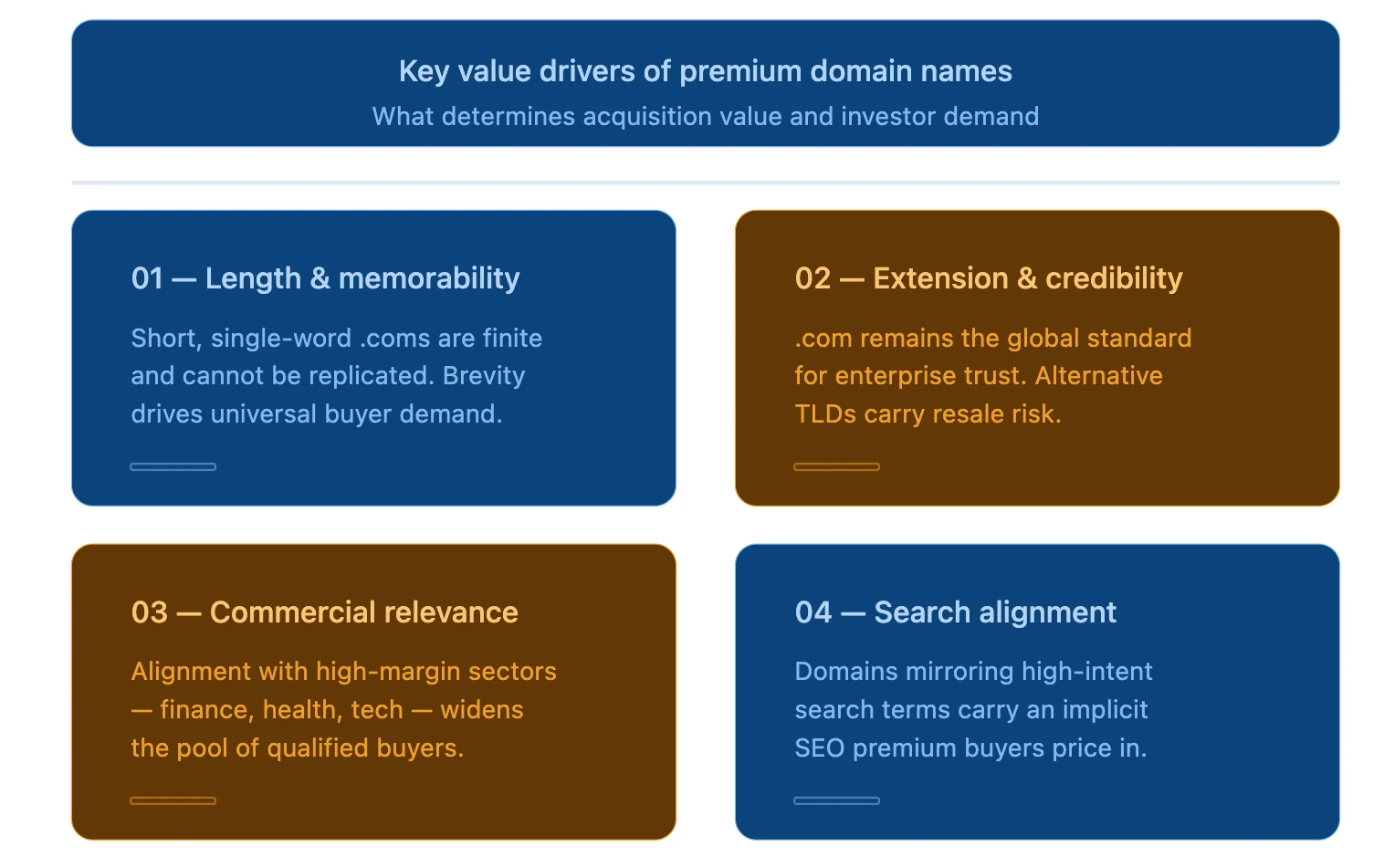
Like any asset, the value of a range is shaped by a combination of factors. Understanding these variables is the foundation of intelligent acquisition.
Length and recall
Short generic names, especially common names with a .com extension, command a high price due to their broad applicability to a wide range of potential end users.
Commercial and industrial relevance
A field related to an industry with high profit margins has primary demand. Buyers need to think in terms of the total addressable market – how many companies could benefit from having this scale?
Search alignment and brand relevance
Domains with strong search terms or common branding patterns have key SEO value, a factor a marketing-savvy buyer will include in any offer.
Expansion and credibility
The .com extension maintains its place as the gold standard for digital authenticity. Enterprise buyer preference for .com remains dominant and shows no structural signs of abating.
How to integrate domain assets into a wealth portfolio
The case for domain assets is further strengthened when one looks at the same from a portfolio construction point of view. Unlike stocks, domain assets do not come with any volatility. The value of the range does not rise or fall depending on market sentiment. Unlike physical assets such as real estate, domain assets do not need any maintenance, and the person does not have any property tax liability.
This makes domain assets essentially a supplementary investment rather than a replacement investment. For a family office responsible for multi-generational wealth management, a carefully selected portfolio of blue-chip assets can act as a store of value with asymmetric return profiles, purchased at a fraction of what the organization’s ultimate value requirements would be.
The caveat, of course, is selectivity. Scale investing is a business where the rewards go to those who apply the same discipline in seeking a purchase as they do in private placement or direct real estate investing. Timing, relevance, and a clear understanding of where capital will go next is what distinguishes an area that will increase in value from one that will not.
Investment Due Diligence: What Sophisticated Buyers Evaluate
Like any new asset class, the investment infrastructure in the areas is still developing; However, it grows quickly. Accuracy related to valuation has increased dramatically with access to comparable sales data, traffic information, keyword economics, and even machine learning algorithms trained on historical transaction volume.
Although still new to traditional investors accustomed to a more rational approach to deal making, the ability to make decisions based on data rather than just instinct alone is a sign that investing in the space has reached maturity as a serious institutional activity.
Long-term investment case for premium domains
Wealth, at its most elastic, has always followed the direction of human interest and trade. In past centuries, the Earth. In the industrial era, infrastructure. In the knowledge age, it was about intellectual property and brand equity.
The Internet is not a stage. It is the operating system of modern civilization. The domain names that are navigated through are, in a very real sense, the addresses of civilization. For the patient and disciplined investor willing to approach this asset class on its own terms, it is neither speculative nor abstract.
It’s structural. And it’s still early.
